MetalsAlloy
How Can You Prevent Warping When Welding Aluminum?
Published:
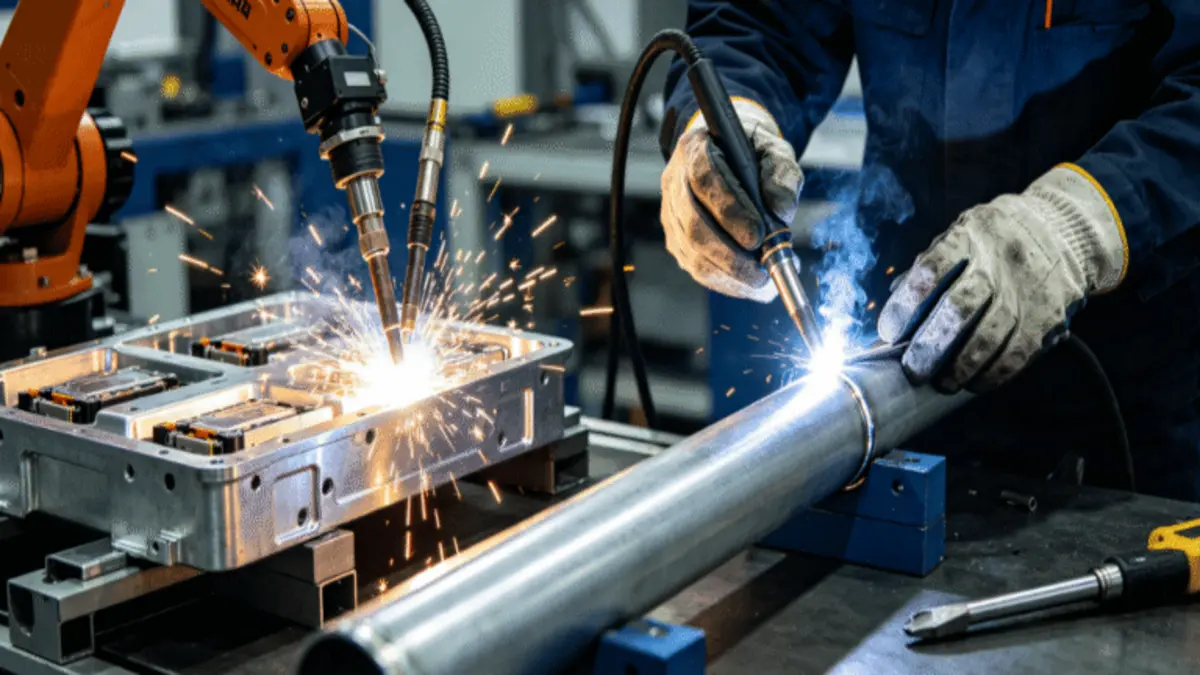
Unwanted distortion and warping are among the most persistent challenges when welding aluminum, especially on large panels, thin gauge material, or assemblies requiring tight tolerances. Aluminum’s high thermal conductivity, low melting point, and unique metallurgical behavior demand special techniques to maintain dimensional accuracy and high-quality welds. This guide delivers practical, source-backed strategies to help fabricators and welders minimize aluminum warpage, comparing process, design, fixturing, and thermal control options for both new builds and repairs.
Why Aluminum Warps While Welding
Aluminum transfers heat swiftly; this rapid conduction causes larger heated zones and amplifies expansion and contraction forces during welding. As the weld and adjacent base metal cool, uneven shrinkage pulls the metal out of alignment—leading to visible bows, waves, or distortion. Unlike steel, aluminum gives little visual warning (no color change) prior to melting, making precision more challenging.
Key factors influencing aluminum distortion and weld warpage include:
- High thermal conductivity: Heat spreads far from the arc, affecting a broad area.
- Low melting temperature: Easy to overheat, especially on thin materials.
- High coefficient of expansion: Aluminum expands and contracts more than steel when heated/cooled.
- Softness and lack of grain structure: More susceptible to permanent deformation under low stress.
- Alloy/temper differences: Some grades are more “weld-friendly” than others.
For these reasons, a systematic approach is vital across material selection, joint design, welding process, and shop practice.
Choose Weld-Friendly Aluminum Alloys and Conditions
Not all aluminum grades behave the same during welding. Matching your product form and condition (sheet, plate, extrusions, T6, etc.) to the application is critical:
| Alloy Series | Common Grades | Weldability | Notes |
|---|---|---|---|
| 1xxx | 1100 | Excellent | Commercially pure, very soft, best for formability and corrosion resistance |
| 3xxx | 3003 | Good | Good general purpose, ductile |
| 5xxx | 5052, 5086 | Excellent | Marine grade, crack-resistant, best for plate & structural work |
| 6xxx | 6061 | Fair | High strength, prone to cracking, use proper filler alloy |
| 2xxx/7xxx | 2024, 7075 | Poor | Highly crack-prone, avoid welding when possible |
- For most weldments, 1100, 3003, 5052, and 6061 are preferred.
- Avoid 2xxx and 7xxx unless necessary; they are for specialty applications and can be troublesome to weld.
- If you must use 6061-T6, expect higher distortion risk, particularly in the heat-affected zone (HAZ).
Product Form/Temper: Warpage occurs more readily on thin sheet and plate than on thick or extruded sections because thinner metal cannot dissipate heat as well, nor resist thermal stress.
How Joint Design Influences Distortion
Optimizing joint prep and assembly design is a cost-effective way to reduce warpage before welding even begins:
- Minimize total amount of weld metal required. Oversized beads create more heat and stress—use only the necessary size for joint strength.
- Use intermittent/staggered welds instead of continuous beads on non-critical seams. This may reduce heat input by 50%–75%, drastically cutting shrinkage.
- Design for symmetry: Avoid long unbroken seams or concentrating welds on one side of a panel; try to alternate sides or use balanced welds.
- Use backing bars or chill strips (ideally copper or aluminum): These absorb and dissipate heat, stabilizing the weld zone, especially for thin sections.
- Fit-up quality: Poorly prepared or oversized root gaps demand more fill, causing excess heat and larger HAZs.
Proven Welding Techniques to Reduce Aluminum Warpage
1. Control Heat Input
Heat input is the most critical variable. Manage it by:
- Lower amperage: Use the minimum current that achieves full fusion and penetration.
- Faster travel speed: Move the torch steadily to avoid excessive heating of any one spot; this limits the heat-affected zone.
- Pulse welding (if available): Alternates high/low current for precise puddle control, reducing bulk heating and allowing the metal to cool slightly between pulses. Particularly useful for thin or intricate pieces.
2. Use Intermittent and Staggered Welds
Rather than laying down a single long bead, weld short sections (stitch or skip welding), allowing time for heat to dissipate between passes. Alternate the weld sequence to balance stress, especially on large panels.
3. Preheat Only When Necessary
For thick sections, preheat can help equalize temperatures and reduce thermal gradients, but avoid preheating thin aluminum alloys—this may worsen warpage.
- Preheat range: typically 150–300°F for thick assemblies if required, but use a temperature stick or IR thermometer to avoid overheating.
4. Sequence Welding Thoughtfully
When welding assemblies:
- Weld from the center outwards to distribute shrinkage evenly.
- Alternate sides on symmetrical parts (welding on one side, then the opposite).
- For box or frame welds, partially weld major seams first, tack, and finish weld sequentially after cooling.
5. Choice of Process: MIG vs. TIG
- TIG (GTAW): Offers best control over heat input, ideal for thin or intricate jobs, but slower.
- MIG (GMAW): Faster, well-suited to thicker sections or production runs. Use pulsed spray mode for moderate thickness and better control.
- Always use 100% argon shielding unless working with heavy plate (use argon/helium blend then).
Effective Fixturing & Clamping for Aluminum Welds
Mechanical restraint is a practical means to limit distortion, especially on large or thin workpieces.
- Use clamps, jigs, or specialty welding tables to immobilize the parts. Secure panels at frequent intervals along the joint.
- Employ copper/aluminum heat sinks or backing bars directly beneath/behind the weld seam to draw heat away.
- Avoid overtightening; allow for some expansion and contraction, or you may introduce new stresses.
For intricate frames or large plate weldments, investing in a modular fixturing system helps keep dimensional integrity through the heat cycle.
Preparation, Cleaning, and Fit-Up
- Remove oxide immediately before welding. Clean with a stainless steel brush dedicated to aluminum, and degrease with acetone or a suitable solvent.
- Prevent contamination: Handle with clean gloves; avoid touching or scratching clean surfaces.
- Ensure square, burr-free edges: Waterjet or saw-cut aluminum to reduce the need for grinding/fitting, which can introduce uneven heat input.
Additional Tips to Minimize Aluminum Distortion
- Do not overweld. Extra weld metal means more heat and larger HAZs; properly size your bead to meet, but not exceed, strength requirements.
- Backstep method: Run the weld in short segments, each starting behind the end of the previous weld, to distribute stress more evenly.
- Post-weld cooling: Allow aluminum to cool slowly, unclamping only after the part has returned near ambient temperature to prevent snap warping.
- Inspection: After welding, check for distortion visually, and use straightedges or measuring jigs as needed. Critical parts may require NDT (dye penetrant or radiographic inspection).
Table: Common Aluminum Grades and Warping Risk
| Alloy | Form | Weldability | Relative Warping Tendency | Best Applications |
|---|---|---|---|---|
| 1100 | Sheet, Plate | Excellent | Low–Moderate | Tanks, ductwork |
| 3003 | Sheet, Plate | Good | Moderate | General fabrication |
| 5052 | Sheet, Plate | Excellent | Low | Marine structures, truck |
| 6061-T6 | Extrusions, Plate | Fair | High (esp. HAZ) | Frames, brackets, beams |
*“Relative Warping Tendency” assumes average gauge and standard process control.
Summary Table: Key Techniques to Prevent Aluminum Warping While Welding
| Technique | Where/When to Use | Effectiveness |
|---|---|---|
| Use of right alloy/filler metal | All assemblies | High |
| Proper joint design/intermittent welds | Panel welds, stiffeners | High |
| Process selection & pulse control | Thin, intricate welds | High |
| Clamping, fixtures, backing bars | Sheet/plate work | High |
| Controlled heat input | Every weld | Critical |
| Preheat (thick only) | Heavy plate, not thin | Moderate |
| Backstep/stitch welding | Long seams, frames | Moderate |
Conclusion: Smart Steps to Prevent Aluminum Weld Distortion
Preventing aluminum warpage during welding is best accomplished by an integrated strategy:
- Select and source weldable grade/temper, with minimal residual stress and proper thickness for the application.
- Design joints to minimize weld metal and use symmetry, intermittent welds, or alternative assembly methods where possible.
- Optimize welding process, lowering heat input with faster travel, pulsed arc, and careful arc control.
- Rigid clamping, fixturing, and use of heat sinks/backing bars stabilize assemblies throughout the process.
- Maintain clean surfaces and precise fit-up to eliminate excess rework, grinding, or unnecessary bead buildup.
Finally, tailor your approach for thin gauge or large panels, where the risk of warping is greatest. These steps, rooted in proven shop practice and expert guidance, deliver consistent, professional results—helping you achieve strong, precise, and attractive aluminum weldments, no matter the scale.
References
Action Stainless. (2025, July 11). Best practices for welding aluminum: Avoiding warping, cracking, and oxidation. https://www.actionstainless.com/best-practices-for-welding-aluminum-avoiding-warping-cracking-and-oxidation
ESAB. (2024, September 16). 12 key steps to minimize distortion in aluminum welding. https://esab.com/us/nam_en/esab-university/articles/12-key-steps-to-minimize-distortion-in-aluminum-welding
Heat control in welding: How to prevent warping and distortion. (n.d.). Siegmund Welding Tables USA. https://weldingtablesandfixtures.com/blogs/the-welders-blog/heat-control-in-welding-how-to-prevent-warping-and-distortion
kevincalori. (2024, July 27). Tips for welding thin metal without warping? [Online forum post]. The Garage Journal. https://www.garagejournal.com/forum/threads/tips-for-welding-thin-metal-without-warping.535762
Seeking advice on keeping aluminum from warping while … [Online forum post]. (n.d.). Reddit. https://www.reddit.com/r/Welding/comments/2ou148/seeking_advice_on_keeping_aluminum_from_warping
storypress. (2026, August 14). How to prevent metal warping while welding. Vern Lewis Welding Supply, Inc. https://vernlewis.com/how-to-prevent-metal-warping-while-welding
Weld distortion. (n.d.). Lincoln Electric. https://www.lincolnelectric.com/en/welding-and-cutting-resource-center/welding-how-tos/weld-distortion
When welding longer runs on 11 gauge or relatively thinner material how do you keep your materials from warping [Status update]. (n.d.). Facebook. https://www.facebook.com/groups/welderamazing/posts/771051750198349