 MetalsAlloy
356.0 Cast Aluminum
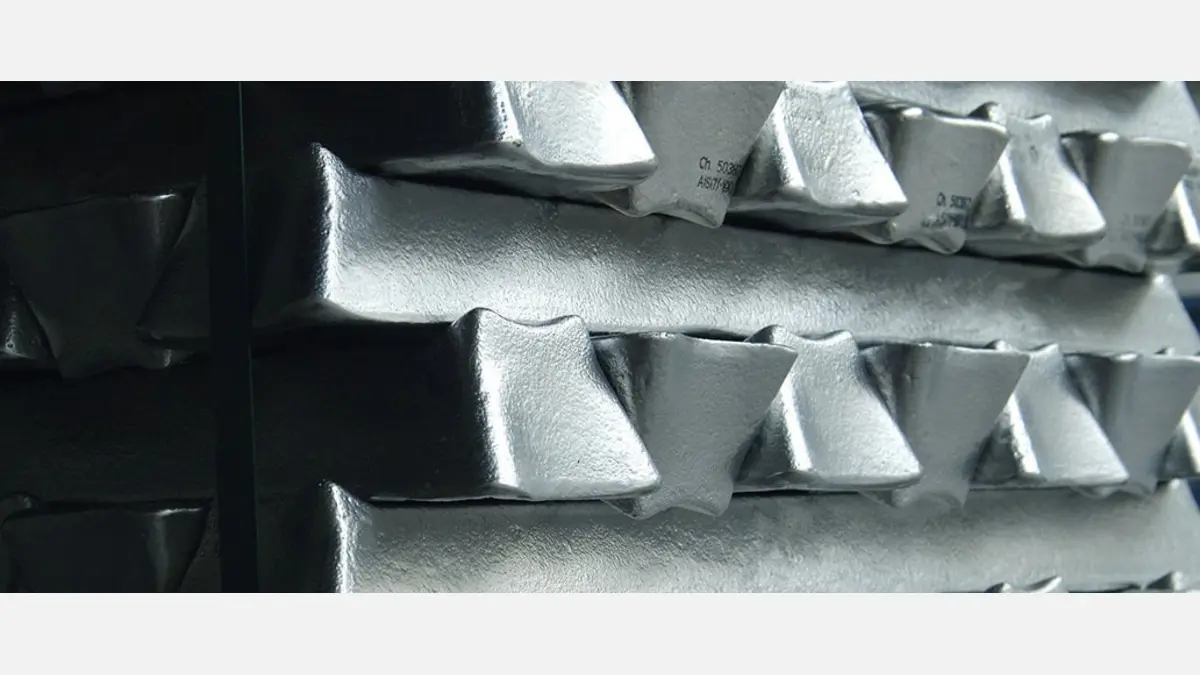
Image Credit: hydro.com
356.0 Cast Aluminum (AA 356.0, UNS A03560) is an Al-Si-Mg casting alloy containing 6.5–7.5% silicon and 0.20–0.45% magnesium. The silicon level gives good fluidity and castability, while magnesium enables useful precipitation hardening after heat treatment. Compared with the lower-iron A356.0 alloy, 356.0 permits more iron and is commonly selected where sound sand castings, good machinability, weldability, and a practical strength-to-weight balance are important. Properties depend strongly on casting quality, section thickness, and condition; the listed F-condition values should not be used as design allowables.
| Chemical Composition wt.% | ||
|---|---|---|
| Element | Min | Max |
| Silicon, Si | 6.50 | 7.50 |
| Iron, Fe | — | 0.60 |
| Copper, Cu | — | 0.25 |
| Manganese, Mn | — | 0.35 |
| Magnesium, Mg | 0.20 | 0.45 |
| Zinc, Zn | — | 0.35 |
| Titanium, Ti | — | 0.25 |
| Other elements, each | — | 0.050 |
| Other elements, total | — | 0.15 |
| Aluminum, Al | Remainder | |
Composition notes
- Aluminum, Al: Reported as remainder; stated range reflects the permitted alloying-element limits.
Registered composition limits are for 356.0 castings, not 356.1 or 356.2 ingot. If iron exceeds 0.45%, manganese shall be not less than one-half of the iron content. Aluminum is the remainder; shown aluminum range is the reported balance range.
Values below are reported for 356.0-F sand cast material unless another condition is stated. The source identifies Aluminum Association-supplied data as not for design. Actual casting properties vary with melt quality, feeding, porosity, section size, and heat treatment.
Use the button to switch between Metric and US Customary units.
| Physical Properties | Metric |
|---|---|
| Density | 2.68 g/cm³2.68 g/cm³ |
| Mechanical Properties | Metric |
| Brinell hardness | 40–70 HBW |
| Ultimate tensile strength | ≥131 MPa |
| Elongation at break | ≥2.0 % |
| Elastic modulus | 72.4 GPa |
| Shear modulus | 27.2 GPa |
| Shear strength | 83.0 MPa |
| Thermal Properties | Metric |
| Linear thermal expansion coefficient (20–100 °C) | 21.4 µm/m·°C |
| Linear thermal expansion coefficient (20–300 °C) | 23.2 µm/m·°C |
| Specific heat capacity | 0.963 J/g·°C |
| Thermal conductivity | 167 W/m·K |
| Solidus temperature | 557 °C |
| Liquidus temperature | 613 °C |
| Electrical Properties | Metric |
| Electrical resistivity | 0.00000400 ohm·cm |
Test conditions & data notes
- Brinell hardness: Typical; 500 g load, 10 mm ball
- Elongation at break: In 50 mm (2 in.) or 4D
- Elastic modulus: Tension
- Shear strength: Calculated
Material Conditions & Tempers
356.0 is supplied in the as-cast F condition and can be heat treated because of its magnesium content. Heat-treatment practice and achieved properties must be qualified for the specific casting process, geometry, and quality level.
| Condition | Tensile Strength | Yield / Proof Strength | Notes |
|---|---|---|---|
| F | ≥131 MPa | Not reported in the supplied source | As-cast condition without special thermal treatment. Reported minimum tensile strength applies to 356.0-F sand cast material; source data are identified as not for design. |
| T4 | Varies by casting and process | Varies by casting and process | Solution heat treated and naturally aged condition, generally used where a balance of strength and ductility is required. Use a casting-specific specification or qualified test data for acceptance values. |
| T6 | Not reported in the supplied source extract | Not reported in the supplied source extract | Solution heat treated, quenched, and artificially aged condition used to obtain higher strength than the as-cast condition. A supplied source identifies 356.0-T6 as a sand-cast condition, but its numerical property data were not available in the extract. |
Advantages & Limitations
| Advantages | Limitations |
|---|---|
|
|
Processing & Fabrication
| Process | Description |
|---|---|
| Sand casting | 356.0 is widely used for sand castings. Sound gating, risering, melt cleanliness, degassing, and feeding are important because shrinkage and gas porosity can dominate component properties. |
| Heat treatment | The alloy can be solution heat treated, quenched, and aged to develop Mg-containing precipitates. Control quench delay and distortion, particularly in castings with large section changes. |
| Machining | Machine only after adequate stabilization where dimensional control is important. Use sharp tools and manage built-up edge; casting skin, hard intermetallic particles, and local porosity can affect tool life and finish. |
| Welding and repair | Clean oxide and contaminants thoroughly before welding. For pressure-tight or fatigue-critical castings, qualify weld repair procedures and inspect repairs because porosity and heat-affected-zone softening can be consequential. |
| Surface finishing | Painting, powder coating, and other protective finishes are suitable after proper cleaning and pretreatment. Finish selection should account for casting surface condition and the service environment. |
Applications
356.0 is suited to weight-conscious cast parts whose geometry benefits from sand casting and whose performance can be improved by heat treatment. It is most appropriate where casting quality controls are matched to the structural, pressure-tightness, and fatigue demands of the component.
- Pump and valve bodies: Its castability supports complex internal passages and external mounting features; alloy selection should be paired with pressure-tightness and corrosion requirements.
- Automotive and transportation castings: The low density and available T4/T6 heat-treatment response help reduce component mass while maintaining practical strength.
- Industrial machinery housings and brackets: Sand casting permits economical production of stiff, integrated shapes with machined mounting faces and bores.
- Electrical and general equipment enclosures: The alloy provides low weight, useful thermal conductivity, and flexibility for complex enclosure geometries.
- Prototype and low-to-medium-volume structural castings: Sand molds offer economical tooling for design iteration, while 356.0 can be heat treated when higher performance is needed.
Standards & Designations
| Designation | Value | Description |
|---|---|---|
| Aluminum Association | 356.0 | Registered designation for aluminum alloy castings; the Aluminum Association Pink Sheets list composition limits for 356.0 separately from 356.1 and 356.2 ingot. |
| UNS | A03560 | Designation associated with 356.0-F sand cast material in the supplied datasheet. |
| ISO | ISO 3522 / R2147 AlSi7Mg | Cross-reference stated by the supplied 356.0-F sand-cast datasheet; verify the applicable edition and product requirements before specification. |
Frequently Asked Questions
What is the difference between 356.0 and A356.0 cast aluminum?
They are distinct registered casting alloys. Both are Al-Si-Mg alloys, but 356.0 permits substantially higher iron and higher limits for several residual elements than A356.0. The lower iron limit of A356.0 is often preferred where ductility and fatigue performance are especially important; the designation on the purchase specification should therefore be preserved exactly.
Can 356.0 be heat treated to T6?
Yes. Its 0.20–0.45% magnesium content gives 356.0 a response to solution heat treatment, quenching, and artificial aging. T6 results depend on the casting process, section thickness, quench effectiveness, and casting soundness, so acceptance properties should come from a qualified casting specification rather than generic values.
Why is iron content important in 356.0 castings?
Iron can form iron-rich intermetallic phases that can reduce ductility and toughness, particularly in less favorable microstructures. 356.0 allows up to 0.60% Fe, and its registered composition includes a conditional manganese requirement when Fe exceeds 0.45%; this helps control the effect of iron-bearing phases.
References & Data Notes
- (n.d.). Aluminum Association, Designations and Chemical Composition Limits for Aluminum Alloys in the Form of Castings and Ingot, Pink Sheets (2025). https://www.aluminum.org/sites/default/files/2025-10/Pink%20Sheets%202025.pdf
- (n.d.). Aluminum 356.0-F, Sand Cast datasheet. https://castritemetal.com/PDF/356_specs.pdf
- (n.d.). Properties of Aluminum 356.0-T6. https://www.scribd.com/document/861227045/Aluminum-356-0-T6-Sand-Cast
Composition limits are presented as mass percent. Numerical physical, mechanical, electrical, and thermal values were reported for 356.0-F sand cast material by the cited datasheet; its Aluminum Association data are explicitly identified as not for design. Confirm current specifications, temper, casting method, and component-specific test requirements before engineering use.